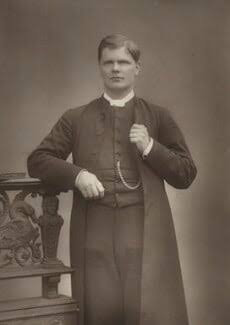
 James Edward Cowell (J. E. C.) Welldon (April 25, 1854 – June 17, 1937) was an influential English clergyman, scholar, and headmaster.
Partner Edward Hudson Perkins
Queer Places:
Eton College, Windsor, Windsor and Maidenhead SL4 6DW
University of Cambridge, 4 Mill Ln, Cambridge CB2 1RZ
Harrow School, 5 High St, Harrow HA1 3HP, United Kingdom
James Edward Cowell (J. E. C.) Welldon (April 25, 1854 – June 17, 1937) was an influential English clergyman, scholar, and headmaster.
Born in Tonbridge, Kent, the son of a schoolmaster, Welldon was educated at Eton College, where he became captain of the school and built a strong reputation in sports like the Wall Game and Field Game. He later played association football as a full-back for the Old Etonians F.C., appearing in the 1876 FA Cup Final. He proceeded to King's College, Cambridge, where he achieved immense academic distinction, sweeping major classical prizes (including the Bell, Browne’s, and Chancellor’s medals) and securing a fellowship.
Welldon served briefly as Master of Dulwich College before embarking on his most famous headmastership at Harrow School (1885–1898). While viewed by some assistant masters as an autocratic administrator, he was widely popular with the boys (who affectionately nicknamed him "the Porker"). Notably, he oversaw the education of a young Winston Churchill, showing great patience with him and maintaining a lifelong supportive friendship with him. He also served concurrently as an honorary chaplain and Chaplain in Ordinary to Queen Victoria.
Leaving Harrow in 1898, Welldon was appointed Bishop of Calcutta and Metropolitan of India. Owing to ill health and conflicts with the Viceroy, Lord Curzon, he returned to England in 1902. He subsequently served as a canon of Westminster, Dean of Manchester (1906–1918), and Dean of Durham (1918–1933).
Welldon was a lifelong bachelor. For nearly fifty years, his household was shared with a close male companion and manservant, Edward Hudson Perkins, whose death in 1932 deeply devastated Welldon. Welldon died in Sevenoaks, Kent, in 1937 at the age of eighty-three.
James Welldon was a member of the Cambridge Apostles, an elite, secretive intellectual secret society founded at the University of Cambridge in 1820. Welldon was elected to the society on February 6, 1875, during his undergraduate years at King's College.
While James Welldon himself was a traditional, conservative Victorian/Edwardian churchman and imperialist, his life intersects with LGBTQ history through two primary vectors:
Historically, the Cambridge Apostles functioned as an environment where homosocial bonding, frank discussions of homoeroticism, and classical Greek ideals of Platonic love flourished as a counter-discourse to rigid Victorian sexual ideology. Over the generations, a significant number of Apostles—particularly in the decades surrounding and following Welldon's time—were known or believed to have experienced same-sex attractions or formed enduring same-sex partnerships (such as figures like E.M. Forster, Lytton Strachey, and John Maynard Keynes).
Welldon lived his entire adult life as an unmarried bachelor. His domestic arrangement—living for nearly five decades with a single male companion and manservant, Edward Hudson Perkins—mirrored a common pattern among Victorian and Edwardian bachelors, academics, and clergymen, providing a socially acceptable household structure for men whose primary domestic and emotional bonds were with other men.
References:
Support this project
This website is a passion project researched, developed, and funded entirely by me. If you find the content valuable and would like to help support the ongoing research and hosting costs, any contribution is deeply appreciated.
Thank you for keeping this independent resource alive!
My books on Amazon: Elisa Rolle's books